Affiliate marketing is one of the largest online industries in the world, quietly powering billions of dollars in sales every year.
Yet despite how big the industry has become, most Australians still don’t fully understand what affiliate marketing actually is, how it works, or why so many creators, publishers, YouTubers, bloggers, influencers, media buyers and online entrepreneurs are involved in it.
Some people think affiliate marketing is just “posting links online.”
Others think it’s some scammy internet business model from the early 2000s.
The reality is very different.
Affiliate marketing today sits at the centre of modern digital commerce. It’s used by massive global brands, software companies, ecommerce stores, financial businesses, travel companies, online educators, media publishers and thousands of independent creators around the world.
And Australians are heavily involved in the industry.
From solo affiliate marketers running niche websites at home to large media companies generating significant affiliate revenue every year, affiliate marketing has become a major part of the online business ecosystem.
In this guide, we’ll break down what affiliate marketing actually is, how it works, the different types of affiliate marketers operating today, the role of AI and traffic generation, and how beginners in Australia can realistically get started in 2026.
What Is Affiliate Marketing?
At its core, affiliate marketing is a performance-based marketing model.
A business rewards a publisher, creator, or marketer for driving traffic, leads, or sales to its products or services.
In simple terms:
You recommend something online. If somebody buys through your referral link, you earn a commission.
That’s the basic concept.
For example:
- A YouTuber reviews software and links to it in their video description
- A blogger writes about web hosting companies
- A comparison website recommends travel insurance providers
- A TikTok creator shares a product link
- An email newsletter promotes a course or tool
- A niche website ranks in Google and sends visitors to ecommerce stores
If a visitor clicks the affiliate link and purchases something, the affiliate earns a commission.
That commission could be:
- 5%
- 20%
- 50%
- Recurring monthly commissions
- Fixed dollar payouts
- Lead generation fees
- CPA payouts
- Revenue share
The structure varies depending on the business, the industry and the affiliate program.
Affiliate Marketing Is Bigger Than Most People Realise
One of the biggest misconceptions about affiliate marketing is that it’s some tiny side-hustle industry.
It’s not.
Affiliate marketing is used by:
- Amazon
- Shopify
- Canva
- HubSpot
- Expedia
- Nike
- Booking platforms
- SaaS companies
- Financial services
- Supplement companies
- Ecommerce brands
- Streaming services
- Education businesses
Many major online companies actively depend on affiliates for customer acquisition.
In many cases, affiliate marketing is simply another form of outsourced digital advertising.
Instead of paying upfront for ads, businesses pay when results happen.
That’s why the model continues to grow.
How Affiliate Marketing Actually Works
The process is fairly simple.
Step 1: A Company Creates An Affiliate Program
A business decides it wants affiliates promoting its products or services.
It creates:
- Affiliate links
- Tracking systems
- Commission structures
- Promotional materials
- Payment rules
- Approval processes
Sometimes this is handled directly by the company.
Other times it’s managed through an affiliate network.
Step 2: An Affiliate Promotes The Offer
The affiliate creates content, traffic or visibility around the product.
This might include:
- Blog articles
- YouTube videos
- TikTok content
- Email newsletters
- SEO articles
- Paid advertising
- Review sites
- Podcasts
- Communities
- Social media content
The affiliate includes their tracking link.
Step 3: A Visitor Clicks The Link
The visitor clicks through to the merchant website.
Tracking cookies or referral systems identify the affiliate as the source.
Step 4: A Sale Or Lead Happens
If the visitor buys, signs up, or completes the required action, the affiliate receives a commission.
That’s the business model.
The Different Types Of Affiliate Marketers
Affiliate marketing has evolved massively over the past decade.
There’s no longer just one type of affiliate marketer.
The industry now includes a wide range of business models and approaches.
Content Publishers
These affiliates create articles, guides and informational content.
Examples include:
- Niche blogs
- Comparison websites
- Review sites
- SEO publishers
- Online magazines
This remains one of the largest areas of affiliate marketing.
YouTubers And Video Creators
Many creators monetise audiences through affiliate links placed in video descriptions, tutorials, product demonstrations and educational content.
Video affiliate marketing has exploded in recent years because people often want to see products, tools and services explained before they buy.
Email Marketers
Some affiliates specialise in building email lists and promoting offers through newsletters and campaigns.
Email remains one of the highest-converting traffic sources online because it allows affiliates to build a direct relationship with their audience.
Paid Traffic Affiliates
These are media buyers who run advertising campaigns through platforms such as:
- Facebook Ads
- Google Ads
- Native advertising networks
- TikTok Ads
- YouTube Ads
They purchase traffic and optimise campaigns for profitability.
This side of the industry is highly data-driven and competitive.
Influencers And Social Creators
Instagram, TikTok, YouTube Shorts and creator platforms have opened affiliate marketing to a new generation of creators.
Not all affiliate marketers look like traditional “internet marketers” anymore.
Many are simply creators monetising audience attention.
Community Builders
Some affiliates build audiences inside communities such as:
- Facebook groups
- Discord communities
- Skool groups
- Forums
- Private newsletters
They monetise trust, recommendations and ongoing relationships.
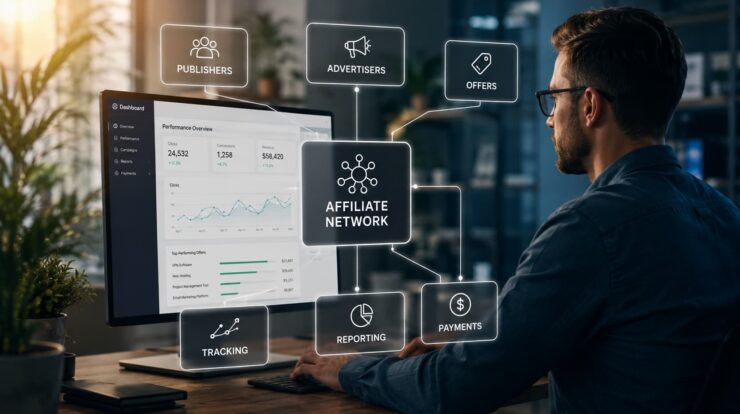
Affiliate Networks Explained
Affiliate networks act as middlemen between businesses and affiliates.
They help manage:
- Tracking
- Payments
- Reporting
- Approvals
- Commission systems
- Affiliate recruitment
Popular affiliate networks used in Australia and globally include:
- Commission Factory
- Awin
- Impact
- Rakuten Advertising
- ClickBank
- Partnerize
- CJ Affiliate
Many Australian ecommerce brands now use affiliate partnerships as part of their growth strategy.
And increasingly, affiliate marketing is becoming more professionalised across Australia.
Why Affiliate Marketing Appeals To Australians
Affiliate marketing has become particularly attractive for Australians because it allows people to build online income streams without needing warehouses, staff, manufacturing, inventory or shipping logistics.
It’s also highly location-independent.
Many Australians involved in affiliate marketing work remotely while travelling, living overseas or building businesses from home.
Others use affiliate marketing as:
- A side business
- A digital publishing model
- A creator monetisation strategy
- An addition to consulting or coaching
- A way to monetise content audiences
- A pathway into online business
Unlike many online business models, affiliate marketing can scale significantly when combined with strong traffic systems.
The Role Of Traffic In Affiliate Marketing
Traffic is the lifeblood of affiliate marketing.
Without visitors, clicks or attention, affiliate commissions don’t happen.
That’s why experienced affiliate marketers spend enormous amounts of time focused on:
- SEO
- YouTube
- Email lists
- Social media
- Paid ads
- Audience building
- Content publishing
- Conversion optimisation
Traffic generation is often the real skill behind successful affiliate businesses.
Not simply “posting links.”
The affiliates who succeed in the long term are usually those who learn to attract their target audiences consistently.
AI Is Changing Affiliate Marketing Fast
One of the biggest shifts happening right now is the rise of AI-powered workflows.
AI tools are changing:
- Content creation
- Keyword research
- Ad creation
- Video editing
- Image generation
- Email writing
- Research workflows
- Publishing systems
- Campaign planning
Some affiliate marketers are now using AI to speed up niche research dramatically, article drafting, campaign planning, offer analysis, and content production.
However, AI is also increasing competition.
Low-quality AI spam content is flooding the internet.
As a result, the affiliates likely to win in the coming years will be those who combine:
- Genuine experience
- Strong positioning
- Audience trust
- Useful content
- Smart AI-assisted systems
- Real marketing judgement
In other words:
AI is becoming a tool, not a replacement for real marketing skill.
Is Affiliate Marketing Still Worth Starting In 2026?
Yes.
But the industry has changed.
The old days of throwing up thin websites filled with low-quality content are fading fast.
Modern affiliate marketing increasingly rewards:
- Authority
- Trust
- Audience building
- Useful content
- Expertise
- Brand development
- Multi-platform traffic systems
The affiliates doing well today often think more like publishers, media companies, creators, educators and marketers.
Not just “affiliate marketers.”
That distinction matters.
Common Beginner Mistakes
Many beginners enter affiliate marketing with unrealistic expectations.
Some of the most common mistakes include:
Chasing Easy Money
Affiliate marketing still requires work, consistency and learning.
It can be powerful, but it is not magic.
Promoting Too Many Random Offers
Successful affiliates usually build around a niche, an audience, a traffic source and a content strategy.
Random links rarely create a serious business.
Ignoring Traffic Skills
Traffic generation is one of the most valuable skills in online business.
Without traffic, nothing else matters.
Relying Entirely On One Platform
Depending entirely on Google, TikTok, Facebook, Instagram, or YouTube can be risky.
Platforms change.
Algorithms change.
Rules change.
Diversification matters.
Building No Brand
The strongest affiliate businesses increasingly operate like media brands.
Trust matters more than ever.
How Beginners In Australia Can Start
For Australians wanting to get started in affiliate marketing, the best approach is usually to keep things simple.
1. Choose A Topic Or Market
Focus on an area you’re genuinely interested in or willing to learn deeply about.
This could be software, finance, health, travel, ecommerce, business, education, hobbies, parenting, fitness, productivity or almost any other market where people buy products and services online.
2. Choose A Traffic Platform
Examples include:
- Website SEO
- YouTube
- TikTok
- Email marketing
- Social content
- Paid ads
Trying to master everything at once usually slows people down.
3. Join Affiliate Programs
Start with relevant affiliate networks or direct programs that match your chosen topic.
The offer should fit the audience, not the other way around.
4. Create Useful Content
Helpful content consistently outperforms hype over the long term.
Reviews, comparisons, tutorials, buying guides, case studies and educational content can all work well.
5. Learn Traffic Generation
This is where real business skills develop.
The better you become at attracting the right people, the more valuable your affiliate business becomes.
6. Think Long Term
The strongest affiliate businesses are usually built steadily over time.
They are based on audience understanding, useful content, consistent publishing and trust.
Final Thoughts
Affiliate marketing is no longer just a niche internet business model hiding in the corners of the web.
It has become a major part of modern online commerce, digital publishing and creator monetisation.
In Australia, the industry continues to grow as ecommerce expands, creators build audiences, brands seek performance-based marketing, AI changes online publishing and more people pursue location-independent income opportunities.
But despite the hype often seen online, successful affiliate marketing still comes back to a few core fundamentals:
- Understanding audiences
- Generating traffic
- Building trust
- Creating useful content
- Making smart partnerships
- Learning modern digital marketing skills
The tools may evolve.
AI may change workflows.
Platforms will rise and fall.
But the core concept remains remarkably simple:
Help connect the right people with the right products and services online.
And when done well, affiliate marketing can become a genuinely powerful digital business model for Australians willing to learn the craft properly.